Not All Paper Folds the Same: Coated Stock, Paper Weight, and Choosing the Right Folder
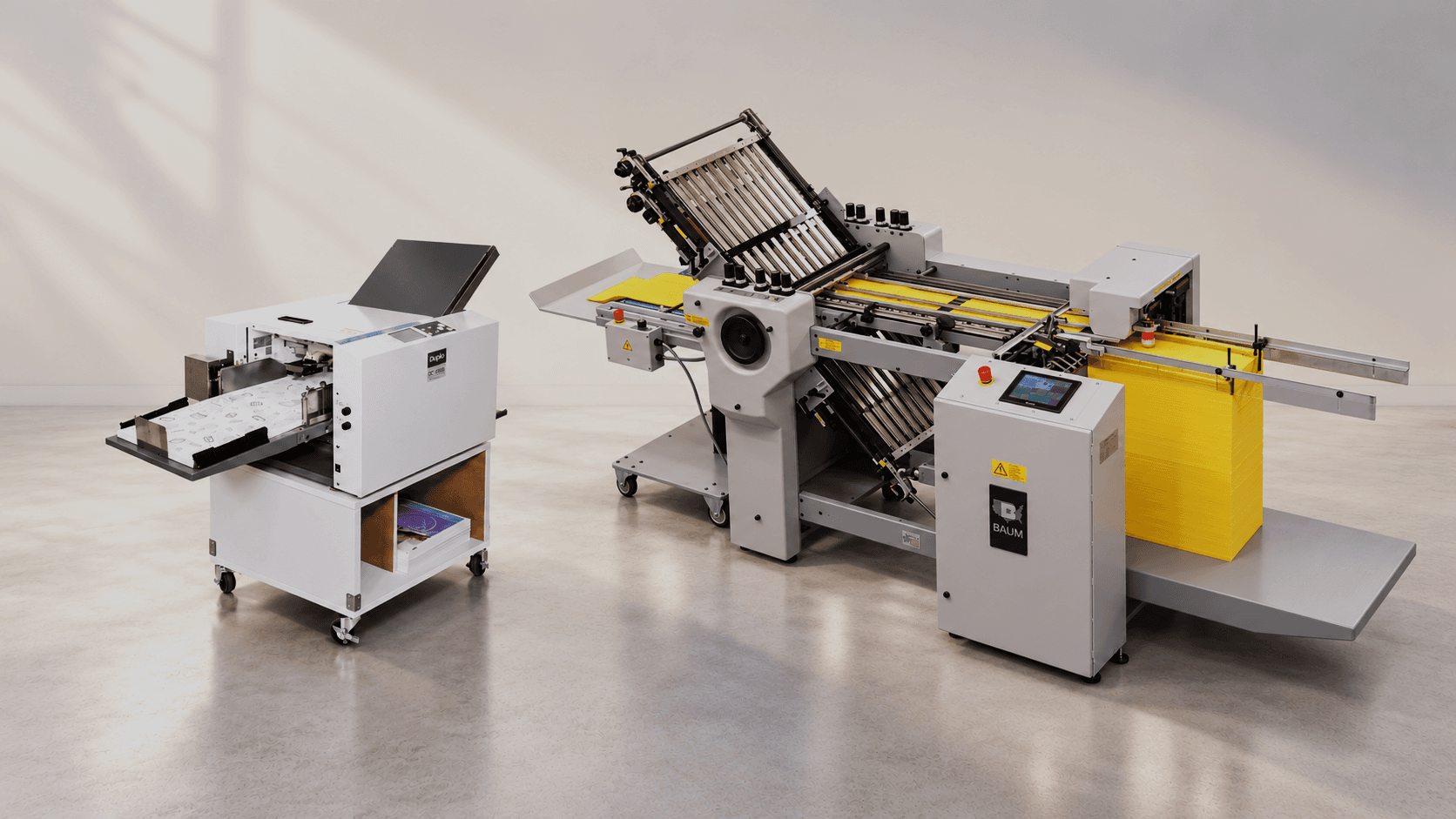
A shop calls us about a folder that "stopped working." The machine is fine. What changed is the job: last month it was 20 lb letters, this month it is a glossy 100 lb cover brochure, and the feeder either grabs three sheets at once or none at all. The folder was never built for that stock. Nobody told them, because the person who sold it never asked what they fold.
Paper folders are sold by speed and fold types, but the two things that actually decide whether a machine will run your work are the surface of the paper and its weight. Get those right and almost any folder in its class will run all day. Get them wrong and no amount of adjustment will fix it. Here is how to think about it.
The two questions that matter: what is the surface, and how heavy is it?
Surface means coated or uncoated. Uncoated stock (bond, offset, text, NCR forms, most letterhead) has a slightly rough, absorbent surface. Coated stock (gloss, silk, matte-coated cover, most digitally printed marketing pieces) has a smooth, slick, sealed surface. Folders feed paper by gripping it, and gripping a glossy sheet is a completely different problem from gripping a dull one.
Weight is the thickness and stiffness of the sheet. A folder built to fold 20 lb bond at 14,000 sheets an hour uses rollers and fold plates sized for thin, flexible paper. A machine that creases and folds 14 pt cover uses a knife and a creasing blade, because heavy stock will not buckle cleanly and will crack along the fold if you force it. These are different mechanisms, not different settings.
Friction feed: the right tool for uncoated work, the wrong tool for gloss
Most desktop and tabletop folders are friction feed. Rubber feed wheels press on the top of the stack and pull one sheet at a time into the fold rollers. It is simple, affordable, fast, and it works very well on uncoated paper. Machines like the MBM 408A run 12 to 80 lb stock at up to 14,000 sheets an hour, and the Duplo DF-990A handles 46 to 157 gsm uncoated in a tabletop footprint. For letters, statements, invoices, church bulletins, and forms, friction feed is the standard.
Put a glossy sheet in the same machine and three things go wrong. The rubber wheels slip on the slick surface, so you get misfeeds. Coated sheets stick to each other, so you get double feeds. And when the wheels do bite, they leave scuff marks on the gloss that the customer sees. Some friction folders list a limited coated range (the DF-990A is rated to about 128 gsm coated), and single folds on heavier stock are often possible, but running a daily diet of coated brochures through a friction feeder is how feed wheels wear out early and jobs come back.
Air feed: built for coated, digital, and heavy stock
Air feed folders separate sheets with air and pick them up with vacuum instead of rubber wheels. Nothing drags across the printed surface, so coated and digitally printed stock feeds without scuffing, and the air blast keeps slick sheets from sticking together. This is the category for a commercial print shop that folds a mix of work.
The Duplo DF-1300L uses an air suction belt with side air and is rated for uncoated 52 to 157 gsm and coated 73 to 157 gsm, with heavier stock possible after testing. The Formax FD 3302 uses the same approach with optical and ultrasonic double feed detection. The MBM 1800S is a top air feed folder rated to 218 gsm at 18,000 sheets an hour. And the Baum 714XLT, a bottom vacuum feed tabletop folder that has been a bindery standard for decades, runs 14 lb bond up to 75 lb cover on the same machine.
If more than a quarter of your folding is coated or printed on a digital press, air feed is not a luxury. It is the difference between a machine that runs and one that sits.
Heavy stock and digital toner: crease first, then fold
Above roughly 170 gsm, and on almost anything printed digitally, a conventional buckle fold cracks. The toner or the coating splits along the fold line and shows a white ragged edge. The fix is to crease the sheet before folding, which compresses the fibers so the stock bends instead of breaking.
That is a different machine. Creaser-folders like the Duplo CF375 XPRO and the Formax Atlas C350 crease and fold in one pass, handling 75 to 400 gsm, which covers everything from text weight to heavy cover and packaging board. The Duplo TF375 PLUS is a knife folder that takes pre-creased sheets from a creaser and folds up to 400 gsm. Greeting cards, menus, brochures on cover stock, presentation folders, and anything off a digital press with heavy ink coverage belong here.
The reverse problem: heavy-stock machines do not do thin paper
This surprises people. A creaser-folder that handles 400 gsm board usually has a minimum around 75 to 80 gsm, and its top speed is roughly 6,000 sheets an hour. Try to run 16 lb NCR forms or a 20 lb statement mailing on it and you have the wrong machine twice over: the thin stock may not feed or crease reliably, and you are folding at a third of the speed a friction or air feed letter folder would give you.
So the shop that buys one machine to "do everything" usually ends up with a machine that does the heavy work well and the daily mail work badly, or the opposite. The honest answer for a shop with both kinds of jobs is often two folders: a fast friction or air feed machine for letter-weight volume, and a creaser-folder for cover stock and digital work. The two machines together frequently cost less than one oversized machine that compromises on both.
A note on grain direction
Even with the right machine, folding against the grain on heavier stock cracks and bulges. Paper has a grain, the direction the fibers lined up on the papermaking machine, and it folds cleanly parallel to the grain. When a heavy-stock job cracks on a machine that should handle it, grain direction is the first thing we check, before anything on the folder.
How to choose, in order
- List your jobs by stock, not by fold type. Uncoated or coated, and the gsm or pound weight of each.
- Mostly uncoated under 120 gsm? A friction feed folder is the fastest and least expensive option.
- Regular coated, digital, or mixed work up to about 220 gsm? Air feed.
- Cover stock, heavy digital, cards, or packaging? A creaser-folder, or a creaser feeding a knife folder.
- Both ends of the range? Plan on two machines and size each for its job.
Before you buy, send us your paper
The spec sheet gives a range. Your stock is a specific case. Before you commit, send us a few sheets of your heaviest and your lightest regular jobs. We match them against the rated range of the machines we carry and flag anything that needs a test run before you spend the money. It takes a few minutes and saves the "it stopped working" call later.
Request a quote, contact us, or browse the full paper folder lineup. And once the right folder is on the floor, a preventive maintenance plan keeps the feed rollers and fold plates in spec so it keeps running the stock it was bought for.