What Can a CO2 Laser Cut and Engrave? A Materials Guide for Print and Sign Shops
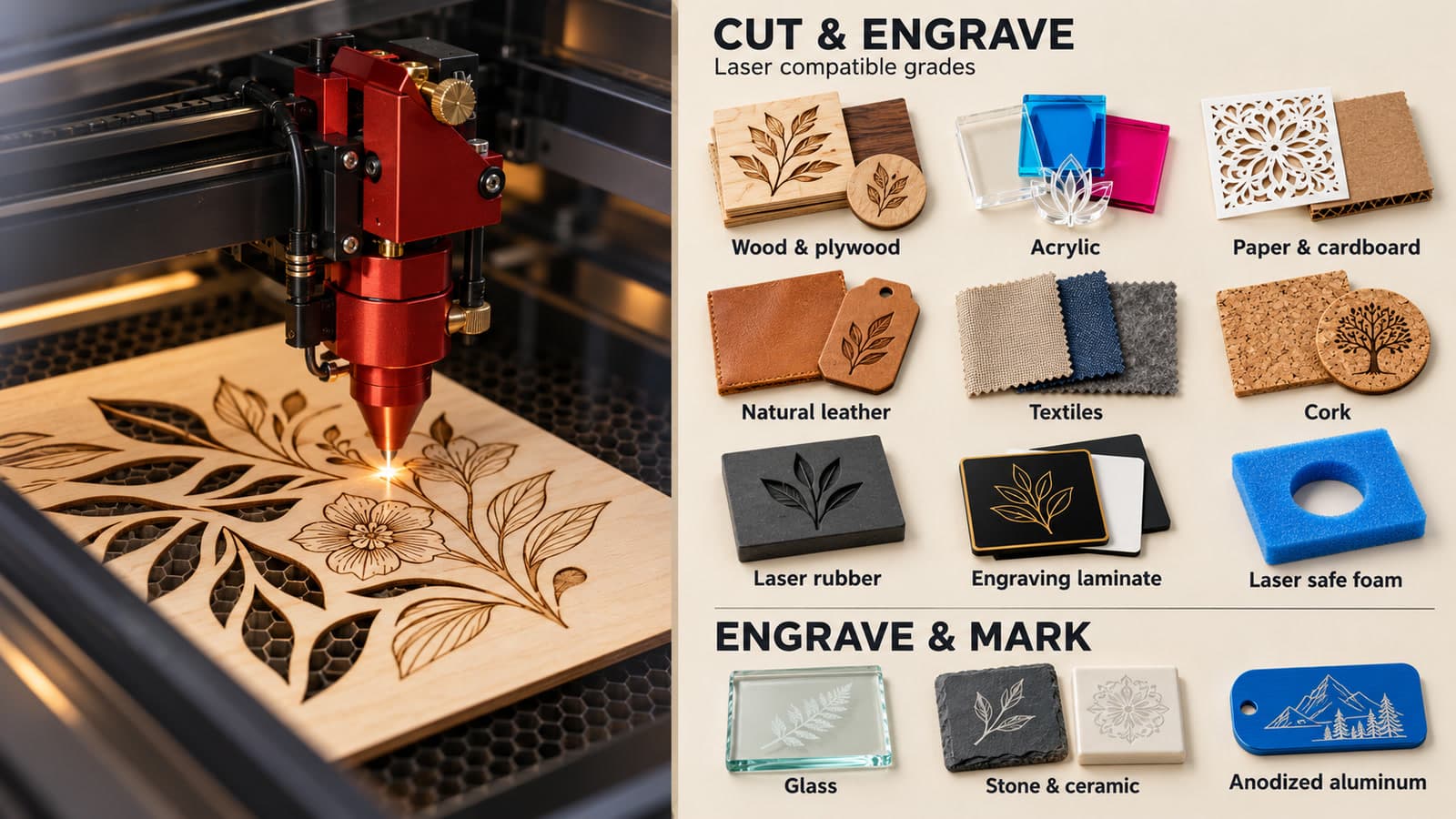
The most common question we get about laser engravers is not about speed or price. It is "can it do this?" followed by a photo of a tumbler, a slab of acrylic, a leather patch, or a piece of stainless. The answer depends on one thing almost nobody explains: what kind of laser it is. This guide covers the CO2 laser, which is the type most print shops, sign shops, and awards businesses buy first, and the type we run on our showroom floor. Here is what it cuts, what it engraves, what it marks, and what should never go inside one.
Why a CO2 laser likes some materials and ignores others
A CO2 laser produces light at a wavelength of 10.6 microns, deep in the infrared. Organic materials and most plastics absorb that wavelength almost completely, which is why the beam turns wood, acrylic, leather, and paper into clean cuts and crisp engravings. Bare metal reflects it. That single fact explains nearly every entry on the lists below.
If your business is mostly metal (industrial tags, stainless parts, firearms, tools), you want a fiber laser or a hybrid machine like the Trotec flexx, which puts a CO2 source and a fiber source in the same cabinet. For everything else, CO2 is the workhorse.
Materials a CO2 laser cuts and engraves
Wood. Plywood, hardwoods, bamboo, MDF, and veneers all cut and engrave well. Engraving produces a natural dark contrast. Resinous woods and some plywood glues can leave a darker burn edge, which some customers love and others want masked with transfer tape. Signage blanks, plaques, awards, cake toppers, and architectural models all live here.
Acrylic. This is the money material for sign shops. Cast acrylic engraves to a frosted white that pops against clear or colored sheet, and it cuts with a polished, flame-finished edge straight off the machine. Extruded acrylic cuts even cleaner but engraves with less contrast, so choose by the job. Lettering, dimensional logos, display stands, LED edge-lit signs, and awards are the common runs.
Leather. Real leather engraves beautifully and cuts cleanly. Patches, journals, belts, wallets, and bag tags are a growing category for shops that already do promotional work. Chrome-tanned leather can discolor at the edge, so test a scrap first. Faux leather is a different story, covered below.
Paper and cardstock. A laser cuts intricate shapes that no die can, with no tooling cost. Invitations, lace-style cards, packaging prototypes, and short-run die-cut work are all practical. For a print shop, this is often the first revenue a laser brings in, because the customers already exist.
Rubber. Laser-rated stamp rubber engraves into finished stamp dies in minutes. If your shop sells Trodat stamps or does custom stamps, the laser replaces the outside vendor.
Fabric and felt. Cotton, felt, polyester, fleece, and denim cut cleanly with a sealed edge on synthetics. Appliqué, patches, and custom cut pieces for apparel decorators are typical.
Cork, cardboard, and foam board. All cut and engrave. Coasters, packaging inserts, and display pieces are quick work.
Delrin and some engineering plastics. Acetal (Delrin) cuts well and is popular for gaskets, jigs, and small parts.
Materials a CO2 laser engraves but does not cut
Glass. The beam fractures the surface into a fine frosted finish. Wine glasses, mugs, awards, and mirrors (engraved from the back) are standard. You cannot cut glass with a CO2 laser.
Stone and tile. Marble, granite, slate, and ceramic tile engrave with excellent contrast, especially dark stone. Memorial plaques, coasters, and photo engraving on black granite are common products.
Anodized aluminum. The laser removes the colored anodized layer and exposes the bright aluminum underneath. Nameplates, control panels, phone cases, and flashlights engrave sharply. This is engraving the coating, not the metal.
Coated and painted metals. Same principle. Powder coat, paint, and enamel come off cleanly to reveal the base metal. This is exactly how the laser tumbler business works: the laser strips the powder coat off a stainless tumbler and leaves a bright stainless design. A rotary attachment holds the tumbler and turns it under the beam.
Bare metal, with help. A CO2 laser will not mark bare stainless, brass, or titanium on its own. Apply a laser marking compound (CerMark and Enduramark are the common brands), run the job, and the laser bonds a permanent black mark to the surface. It is an extra step and an extra consumable, but it works for small volumes. If bare metal marking is a daily job for you, the fiber source on a flexx machine does it in one pass with no spray.
Materials that should never go in a CO2 laser
This is the part most sellers skip, and it matters, because the wrong material can damage a machine or hurt the operator.
PVC and vinyl. Never. Lasering PVC releases chlorine gas, which becomes hydrochloric acid when it meets moisture. It corrodes the optics, the rails, and the electronics inside the machine, and the fumes are dangerous to breathe. Vinyl sign material, vinyl banners, PVC foam board, and most "vinyl" labels are all on this list. If you are unsure whether a plastic contains chlorine, do not run it.
Faux leather and "vegan leather." Much of it is PVC. Some is polyurethane, which is fine. Unless the supplier confirms PU, treat it as PVC.
Polycarbonate (Lexan). It cuts poorly, discolors to yellow and brown, catches fire easily, and the fumes are toxic. Use acrylic instead; most customers cannot tell the difference in a finished sign.
ABS. Melts rather than cuts, leaves a gummy edge, and produces cyanide gas in the fumes. Skip it.
Fiberglass and carbon fiber. The epoxy resin fumes are hazardous and the glass fibers damage optics.
Polystyrene foam and polypropylene. Both catch fire and melt into a mess that is hard to clean out of the machine.
Anything with a mirror finish facing up. Reflective metal can bounce the beam back into the lens. Engrave mirrors from the coated back side.
A good rule for an unknown material: if nobody can tell you what it is made of, it does not go in the laser.
Does wattage change what you can cut?
Wattage mostly changes thickness and speed, not the list of materials. As a working guide, a 60 W CO2 laser cuts quarter-inch acrylic and most plywood cleanly. Half-inch acrylic and thicker hardwoods want 80 W or more. Engraving quality depends more on the optics and motion system than on raw power, which is why a well-built 60 W machine engraves better than a cheap 100 W one.
The Trotec Speedy 360 we keep on our showroom floor is a good reference point: a 32 by 20 inch work area, CO2 options from 60 to 120 W, 8.2 inches of clearance for thick pieces and tumblers, and up to 140 inches per second engraving speed. The Speedy 300 and Speedy 400 cover smaller and larger formats with the same build.
Bring your material and find out for sure
Reading a list is one thing. Watching your own material run is another. We keep the Speedy 360 running in our Miami showroom, and the best way to answer "can it do this?" is to bring the tumbler, the acrylic, the leather, or the slate and put it on the table. We will set it up, run it, and tell you honestly what it will and will not do.
Request a quote or contact us to schedule a time, or browse the full laser engraver lineup. And if you are weighing a laser against sending engraving work out, our guide to the ROI of a laser engraver walks through the math.