Used vs. New Print Finishing Equipment: A Practical Buyer's Guide
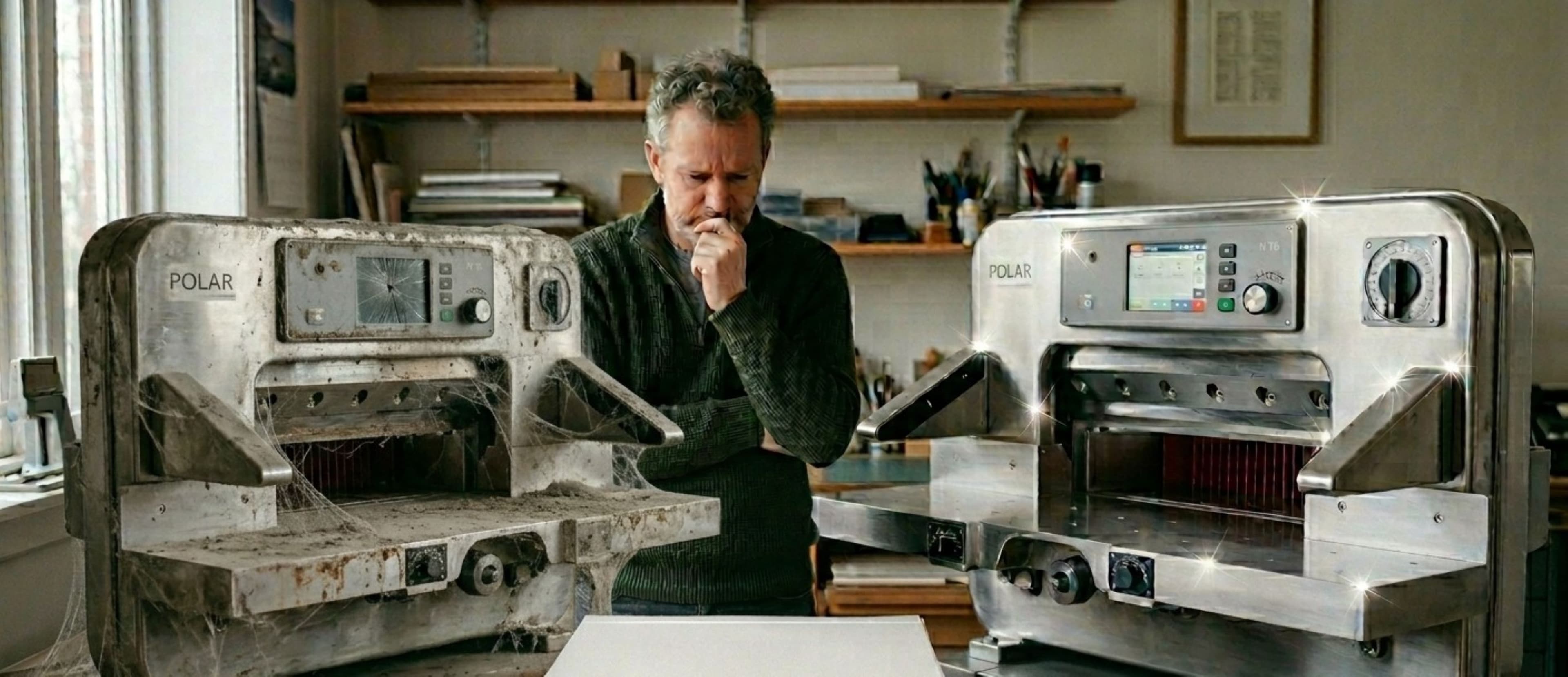
Every print shop owner faces this decision sooner or later: do you buy new finishing equipment with the full warranty and the latest features, or do you save thousands by buying used? It's one of the most consequential financial decisions a print operation can make — and the right answer isn't the same for every shop.
At PressTech LLC, we've helped South Florida print shops navigate this choice for four generations. We sell and service both new and pre-owned equipment from brands like Duplo, Formax, Drylam, MBM, Challenge, and Trotec. We've seen used purchases that paid for themselves in three months, and we've seen "bargains" that turned into money pits within a year.
Here's the honest breakdown of when each option makes sense, what to look for, and how to avoid the most common mistakes.
The Case for Buying New
New equipment isn't just about prestige. There are real, tangible reasons to spend the extra money on a brand-new machine.
Full Manufacturer Warranty
A new machine usually comes with one to two years of warranty coverage. If something fails, parts and labor are covered. That predictability matters for production shops that can't afford unexpected downtime — and it matters for cash flow planning. You know exactly what your equipment costs to operate for the first few years.
Latest Technology and Software
Finishing equipment has evolved fast over the last decade. Newer cutters offer faster programmable setups, better safety systems, and tighter accuracy. Newer folders handle a wider range of stocks with less operator adjustment. Newer laminators run faster, more reliably, and with better adhesion control. If you're trying to compete on speed and quality, the gap between a 2026 machine and a 2014 machine is real.
Financing and Lease Options
Manufacturers and dealers offer financing programs on new equipment that often beat what you can get on used. Leasing can move equipment off your balance sheet entirely and provide tax advantages. These options can make a new machine more affordable on a monthly basis than a used one bought outright.
Predictable Service Life
A brand-new machine has zero wear. You know its history because you're writing it. You control the operator training, the maintenance schedule, and the operating environment from day one. The variables are minimized.
Best for High-Volume Production
If a machine is running eight hours a day, five days a week, the math usually favors new. Downtime on a high-volume production line is expensive. The premium for a new machine is small compared to the cost of a single week of lost production from a used unit that needs a major repair.
The Case for Buying Used
Used equipment is where smart shops find real value — when they buy carefully.
Significant Upfront Savings
A well-maintained used finishing machine often runs 40-60% less than a new equivalent. On a $40,000 piece of equipment, that's potentially $20,000+ back in your pocket — money you can put toward materials, marketing, or another machine.
Proven Reliability
Some finishing equipment is over-engineered to the point that a 15-year-old machine can run for another 15 years with proper care. Many of the workhorse models from brands like Challenge, Baum, MBM, and Duplo were built to last decades. If you find one that's been maintained well, you're often buying proven reliability at a discount.
Lower Depreciation Risk
A new machine loses 20-30% of its value the moment it leaves the dealer. A used machine has already taken that hit. If your business needs change and you have to sell, you'll recover more of your investment.
Faster Availability
New equipment often involves order lead times of weeks or months. Used equipment when available, can usually be inspected, purchased, delivered, and installed within days. For shops that need to add capacity immediately to win a contract, used is often the only realistic option.
Best for Lower Volume and Backup Capacity
If you need a machine that runs a few hours a day, or a second unit to handle overflow and act as backup, used is almost always the smarter buy. The economics don't justify new for occasional use.
What to Inspect Before Buying Used
This is where most buyers get into trouble. They see a clean exterior, hear the machine run for thirty seconds, and write a check. Then the problems start showing up.
Here's what a serious used equipment inspection actually covers:
Service History
Ask for documentation. A well-maintained machine has records — service invoices, parts receipts, and preventative maintenance logs. No records doesn't automatically mean a bad machine, but it does mean you're buying blind. Adjust your offer accordingly.
Operating Hours
Most production equipment tracks hours of operation through onboard counters. Compare the hours against the machine's age. A 10-year-old machine with 2,000 hours has been lightly used. The same machine with 25,000 hours has been worked hard. Both can be good buys at the right price — but the price should reflect the reality.
Mechanical Wear
A trained eye can spot wear on rollers, blades, belts, gears, and bearings. Look for excessive play in shafts, glazed or cracked rollers, frayed belts, and any signs of corrosion or oil leaks. On cutters specifically, inspect the blade and clamp surfaces — replacement blades and clamp sticks are expected wear items, but underlying frame damage is a serious red flag.
Electronics and Controls
Power the machine up. Cycle through every menu and function. Touchscreens, control panels, and PLCs are the most expensive components to replace. A flickering screen, unresponsive buttons, or error codes the seller can't explain are warnings, not negotiating points.
Test With Real Material
Don't accept a "watch it run" demo. Bring your own paper stock and run an actual job. Cuts should be square. Folds should be sharp and consistent. Laminated output should be bubble-free and properly bonded. If the seller resists running a real test, walk away.
Parts Availability
Some older equipment is fantastic — but parts are scarce. Before buying anything more than 10 years old, confirm that critical replacement parts are still available from the manufacturer or aftermarket suppliers. A great machine you can't get parts for is a paperweight when something breaks.
Red Flags That Should Stop the Sale
Walk away from any used machine with these signs:
- Refusal to allow professional inspection. A legitimate seller welcomes a third-party tech going through the machine.
- "As-is, no returns" with no demonstration. That language plus no live demo means problems are being hidden.
- Recent paint or aggressive cleaning. Sometimes it's just pride of ownership. Sometimes it's hiding rust, oil leaks, or damaged surfaces.
- Vague answers about service history. "It's been well maintained" is not an answer. Documentation is an answer.
- Sellers in a hurry. If the price keeps dropping and you're being pressured to decide fast, ask yourself why they're so motivated.
- Off-brand or orphan equipment. Avoid machines from manufacturers that are out of business or have abandoned the product line. Parts and service support evaporate.
When Used Is a Mistake
There are situations where used equipment is the wrong call, even at a steep discount:
- High-volume mission-critical production. When the machine has to run, every day, with no exceptions, the warranty and predictability of new is worth the premium.
- You're not technical and don't have a service relationship. Used equipment requires more attention. If you don't have a trusted service tech on call, buy new and get the warranty.
- The technology gap is too wide. A 20-year-old folder might work, but if it can't handle modern digital stock or run at competitive speeds, you're saving money on the purchase and losing it on every job for years.
- The savings are marginal. If a used machine is 15% less than new but lacks warranty and has unknown history, that's not enough discount to take on the risk.
When New Is a Mistake
And there are situations where buying new is overkill:
- Backup or overflow capacity. A second machine that runs occasionally doesn't need to be the newest model.
- Tight budget, immediate need. A reliable used machine that's available now and within budget beats a new machine you can't actually afford.
- Testing a new service offering. Before you commit $60,000 to find out if there's demand, prove the market with a used unit at half the price.
- Stable, well-understood applications. If you're doing the same job today that you'll be doing in five years and the technology isn't advancing fast, used is fine.
A Smart Hybrid Strategy
Many of the most profitable shops we work with use a hybrid approach: buy new for high-volume production lines where uptime is critical, and buy used for backup units, secondary operations, and capacity expansion. They get warranty and performance where it matters most, and they stretch their capital with used equipment where it doesn't.
This approach also smooths out replacement cycles. Instead of facing one massive equipment upgrade every decade, you're rotating in one new and one used machine every few years — keeping the overall fleet modern without huge capital spikes.
Why Buy From a Dealer Instead of a Private Seller
Online marketplaces and auctions can offer the lowest prices on used equipment. They also offer the highest risk. When you buy from an established dealer, you get:
- Equipment that's been inspected and serviced before resale, not "running when removed"
- Honest disclosure of known issues with the option to address them
- Installation, training, and service support included or available
- A relationship that continues after the sale — somebody to call when you need parts or help
- Trade-in value when you're ready to upgrade
The premium over a private sale is real, but so is what you're getting for it. We've seen too many shops buy auction equipment that arrived broken, mismatched, or missing critical components — with no recourse.
How PressTech Helps
At PressTech LLC, we work with shops at every budget and every stage. We carry new equipment from the industry's leading manufacturers, and we also handle quality pre-owned equipment that's been thoroughly inspected and serviced by our techs. Either way, we provide:
- Honest consultation about which option actually fits your business
- Professional installation and operator training so you're production-ready
- Local service and support across South Florida from technicians who know these machines
- Service contracts to keep predictable operating costs whether your equipment is new or used
- Trade-in and upgrade programs when your needs change
We're not interested in selling you the most expensive option. We're interested in selling you the right option — because we'll be the ones servicing it for the next decade.
Trying to decide between used and new? Contact PressTech LLC for a no-pressure consultation. We'll talk through your volume, your budget, and your growth plans, and help you make the call that actually makes sense for your shop.
Phone: (786) 916-3713 Email: info@presstechllc.com Web: presstechllc.com
PressTech LLC is a fourth-generation family-owned print and finishing equipment dealer based in Miami. We sell, install, and service both new and pre-owned equipment from 11 major brands throughout South Florida. Located at 20243 NE 15th Ct, Miami, FL 33179.